Great Kills Park
Park · Staten Island
Great Kills Park is a sandy peninsula of more than 500 acres on Staten Island's South Shore, with Great Kills Harbor inside its bounds.
- 0.84 square miles
- 5 street corners
- 9 bus routes
The City bought Crooke's Point and nearby land in 1929, and the park and harbor were built in the 1940s under parks commissioner Robert Moses; the park opened to the public in 1949 and in 1972 became part of the National Park Service's new Gateway National Recreation Area. It offers a beach, a marina, a multi-use path, bird-watching and fishing at Crooke's Point.
Sources: Great Kills Park - Gateway National Recreation Area (National Park Service); Great Kills Park (National Park Service); Great Kills Park (The Cultural Landscape Foundation); Great Kills Park (Wikipedia).
Great Kills Park borders two areas.
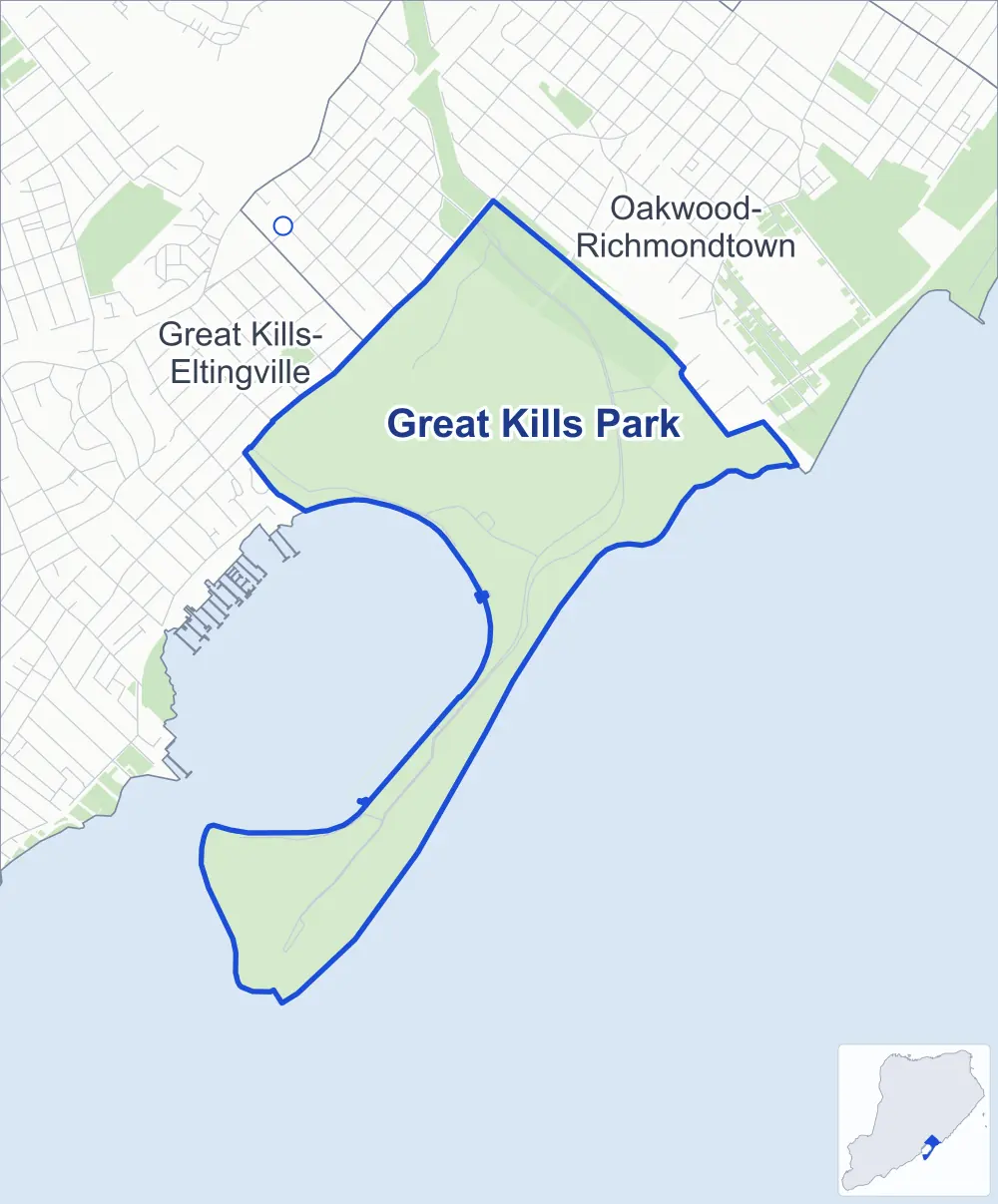
- Great Kills Park
- A neighboring area
- Park
- Another station
Neighborhood areas and streets: NYC Department of City Planning. Parks: NYC Parks. Stations: MTA.
Neighboring areas
- Oakwood-Richmondtown northeast
- Great Kills-Eltingville northwest
Getting around
Buses on nine routes stop in or at the edge of Great Kills Park.
- 2 local bus routes
- 7 express bus routes
Local bus routes
- S78
- S79-SBS
Express bus routes
- SIM1
- SIM1C
- SIM5
- SIM6
- SIM7
- SIM9
- SIM10
Safety record
Between 2021 and 2025, its corners averaged fewer police-reported crashes than the average Staten Island corner.
- 1 police-reported crash at its corners
- 0.2 a corner, on average
- 2.2 the average Staten Island corner
- 4 corners with a clean record
Camera tickets
In 2025 the Department of Finance recorded no red-light, school-zone speed or bus-lane camera ticket at its corners.
Parks
- Parkland
- 43.5 acres of Great Kills Park, as NYC Parks maps it within the area's boundary
Streets and trees
- Trees
- 43 in NYC Parks' records, most often black locust, goldenrain tree and mulberry
- Height above sea level
- From 8 feet at Buffalo Street & Gravel Road Esplanade to 13 feet at Buffalo Street & Great Kills Park Driveway
Street corners
How the figures above are measured: Methodology.